How to Write a Novel with AI: A Practical Step-by-Step Workflow
Use AI for a novel without losing control of the story: move from premise to outline, scene beats, draft, and revision with bounded prompts and explicit context.
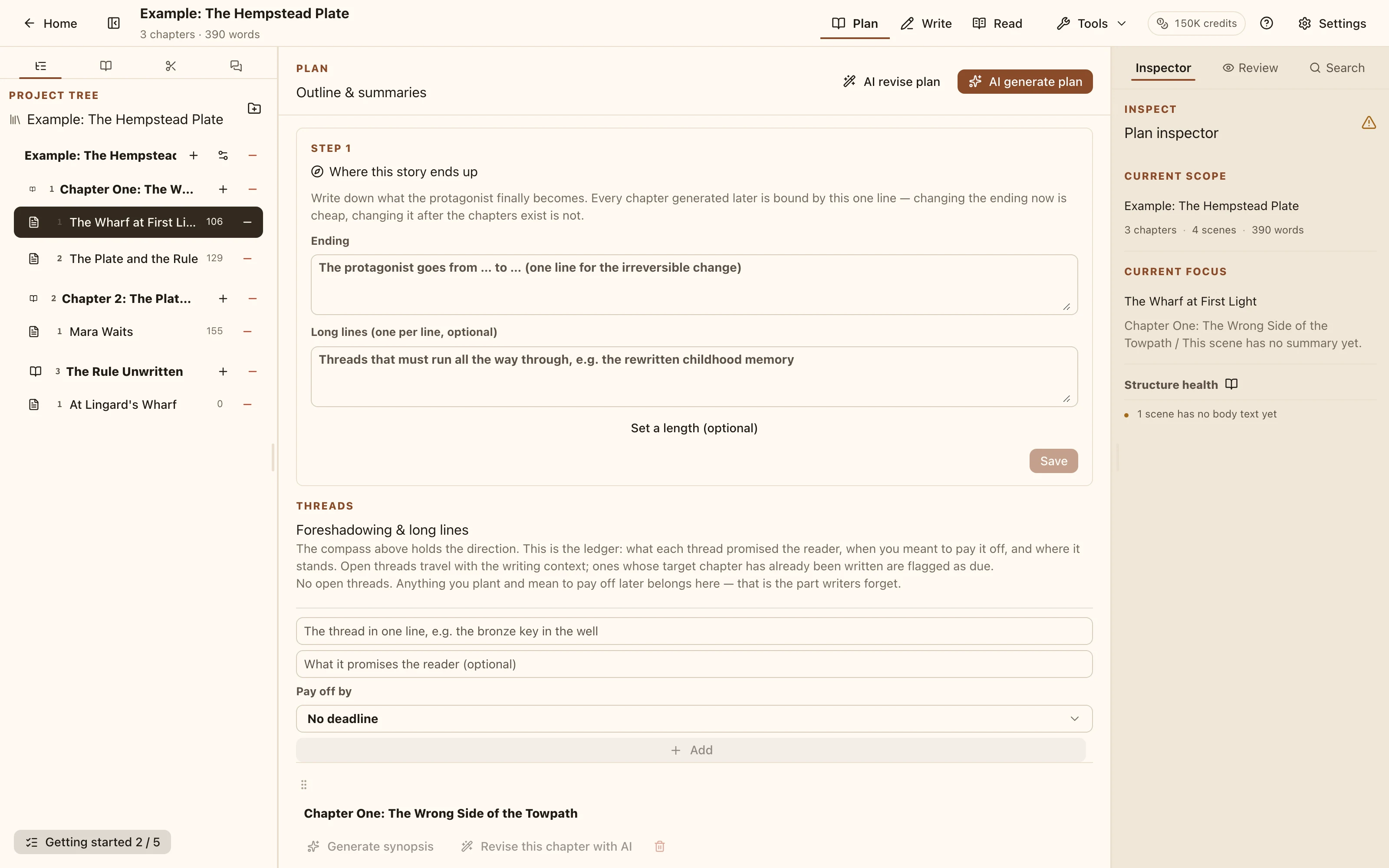
Plan workspace The most reliable way to write a novel with AI is to work in stages: premise, outline, scene beats, prose, and revision. Give the model one bounded task at a time, preserve the facts that are already established, and review every suggestion before it becomes part of the manuscript.
AI can help with decisions, alternatives, and draft language. It should not silently decide your story's facts, character knowledge, or ending. The workflow below keeps those decisions visible.
1. Define the premise before asking for prose
Start with a protagonist, a goal, resistance, and a cost of failure:
Protagonist: A harbor archivist looking for proof of her mother's disappearance.
Goal: Find the missing record before the archive relocates tomorrow.
Resistance: The director controls the storeroom key and is destroying files.
Cost of failure: The last evidence leaves with the archive's collection.
If your premise is only “write a fantasy novel,” ask AI for questions or possible conflicts, not a chapter. Choose the direction yourself. A premise is useful when it forces a character to act.
2. Prepare a minimum context packet
Long fiction needs more than a prompt pasted into an empty chat. Before drafting a scene, collect only the facts that can affect that scene:
| Context | What to record | Why it matters |
|---|---|---|
| Viewpoint | Close third person through Mara | Limits what the prose may reveal |
| Current goal | Obtain the storeroom key | Gives the scene direction |
| Known facts | The letter has a missing page | Prevents accidental contradiction |
| Character boundary | Mara suspects the director but lacks proof | Protects the tension |
| Exit state | She has the key at a cost | Makes the next scene actionable |
Reference notes are not automatically relevant just because they exist. In a writing workspace, keep characters, locations, and rules organized, then select or verify the entries that belong to the current scene.
3. Turn the outline into scene beats
An outline becomes draftable when each scene has a goal, resistance, turn, and ending state:
Scene: The key exchange
Entry state: Mara has the letter and no key.
Goal: Convince the director to open the storeroom.
Resistance: He demands the original letter in exchange.
Escalation: He announces the collection leaves at dawn.
Turn: Mara realizes he has not seen the copy she made.
Choice: She offers the copy and pretends it is original.
Exit state: She has the key, but the director may discover the deception.
Ask AI for three possible turns if you are stuck. Do not ask it to write the whole chapter until you have chosen the cause-and-effect sequence you want.
4. Generate one bounded scene
Use a prompt that states both the task and the limits:
Task: Write the key-exchange scene in approximately 500 words.
Viewpoint: Close third person through Mara; show only what she observes or infers.
Goal: She needs the storeroom key tonight.
Resistance: The director wants the original letter.
Preserve: Mara has no proof of his involvement yet.
Do not: Reveal the mother's fate, add a rescuer, or resolve the mystery.
Style: Restrained dialogue; show distrust through pauses and specific actions.
Ending: Mara leaves with the key and a new risk.
Output: Prose only.
The output length is guidance, not a contract. If the scene misses the turn, repair the goal or resistance instead of adding vague instructions such as “make it more exciting.”
5. Revise for story facts before style
Review the generated passage in this order:
- Does each character act on information they actually have?
- Does every major action follow from the preceding action?
- Did the scene reach the intended ending state?
- Did the model introduce an object, person, rule, or backstory that was not supplied?
- Does the language sound like the project's intended voice?
Fix continuity and causality before polishing sentences. A beautiful paragraph that changes who owns the key is still a broken draft.
6. Record accepted story state
After keeping a scene, write a short state update:
Accepted facts: Mara obtained the key and gave the director a copy of the letter.
Who knows: The director believes the copy is the original; Mara does not know he searched the storeroom.
Unresolved: Why was the letter altered?
Next pressure: Mara must enter the storeroom before the director checks the document.
Keep discarded alternatives out of the accepted notes. Otherwise a later generation may treat an unused suggestion as canon.
What can go wrong?
Can AI write an entire novel in one request?
It can produce a large amount of text, but one request does not provide a reliable mechanism for preserving character knowledge, chronology, causality, or your voice. Stage the work and review each accepted scene.
How much context should I include?
Include the facts that can change the current decision: viewpoint, goal, resistance, relevant history, and ending state. More text is not automatically better; contradictory or irrelevant notes make review harder.
Should I use AI for planning or prose first?
Use it for planning when the next decision is unclear. Use it for prose when the scene's purpose and boundaries are already clear. Switching between those modes deliberately prevents a draft from hiding an unresolved story problem.
Turn this guide into your next scene
Keep your outline, character notes, and draft together in NovelKnow. Start with one scene and review each AI suggestion before keeping it.