Character Profile Template: Keep Novel Facts and Timelines Consistent
Copy a practical character profile template and learn to separate stable facts, motivation, relationships, and scene-specific knowledge in AI-assisted fiction.
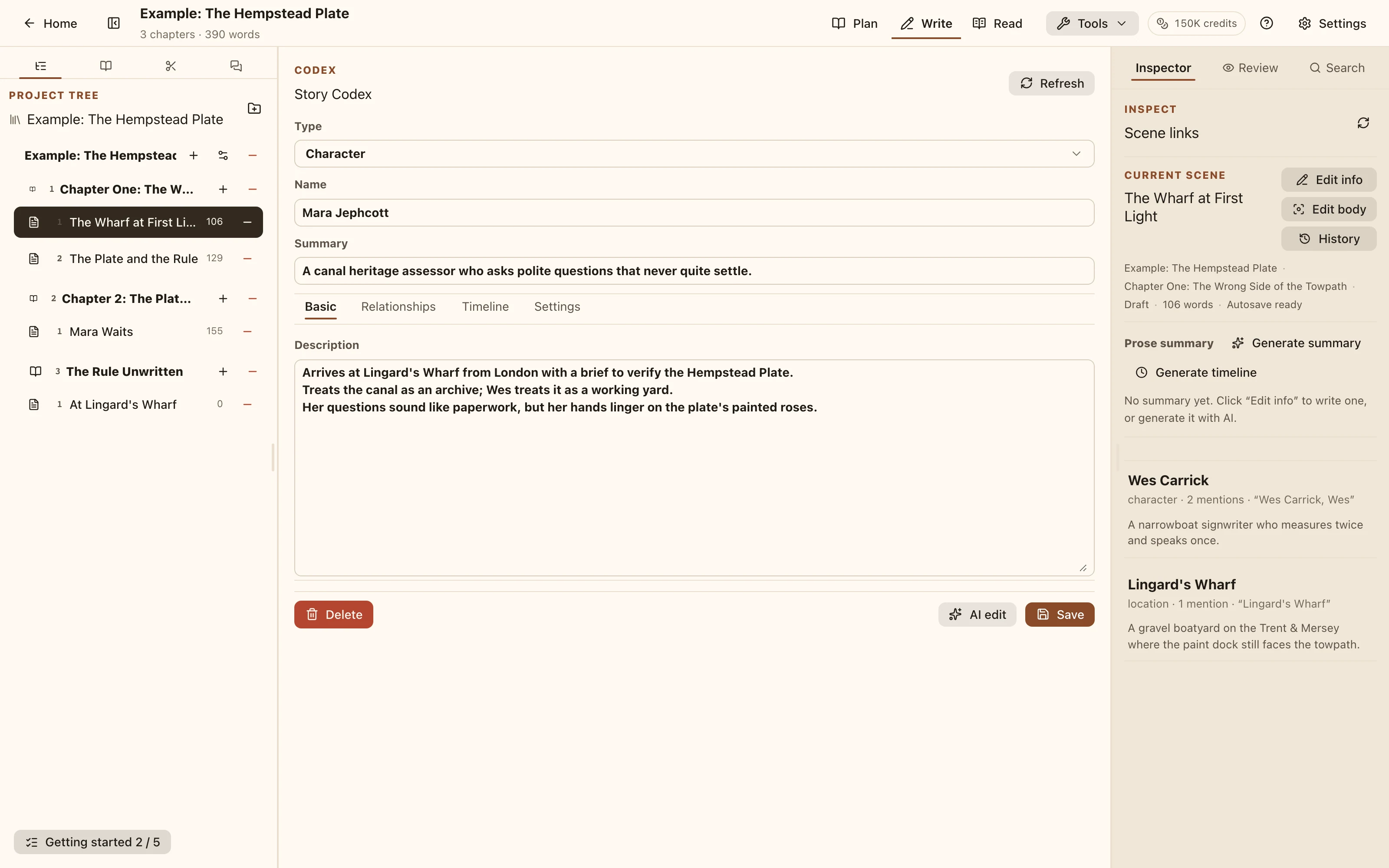
Codex workspace A useful novel character profile records stable facts, actionable motivations, relationship conflicts, and changing story state. Height, hair color, and personality labels describe someone. What that person currently knows and what they are willing to sacrifice determine their choices in a scene.
The example below uses Mara, an invented archivist investigating a disappearance. Keep the template in ordinary notes or organize it as a NovelKnow Codex entry.
1. Copy this character profile template
Name and aliases:
Role in the story:
Stable facts: age range, occupation, established history, ability limits
External goal: what the character wants now
Internal need: what they must acknowledge or change
Fear of loss: what could push them into a bad decision
Behavioral boundary: what they refuse to do under pressure
Expression: speech patterns and gestures, including ones to avoid overusing
Key relationships: trust, debts, misunderstandings, and power differences
Current state: knowledge, possessions, injuries, and allegiances
Unrevealed information: author-only secrets to isolate as needed
You do not need to fill every field immediately. Establish the goal, boundary, and key relationship, then write a conversation under pressure. Add details when they affect a choice. This prevents preparation from becoming a substitute for drafting.
2. Turn personality labels into observable choices
“Mara is clever, cautious, and determined” does not establish how she responds when the director demands a document in exchange for a key. Convert labels into testable behavior:
| Abstract label | More actionable characterization |
|---|---|
| Cautious | Makes a copy before surrendering a document, without admitting it |
| Determined | Risks her job to investigate her mother, but will not implicate a colleague |
| Reserved | Avoids discussing her grief but identifies errors in records precisely |
These constraints do not freeze the character. If she later crosses a boundary, dramatize the pressure and cost, then record the change in her timeline. Development becomes visible when readers can compare the new choice with an established earlier one.
3. Separate the base profile from changing state
“Mara is an archivist” belongs in the base profile. “Mara knows the director lied” becomes current state only after that discovery occurs.
| Story point | Knowledge | Relationships and possessions |
|---|---|---|
| Before scene one | Her mother visited the archive | Trusts the director; holds an incomplete letter |
| End of scene two | He concealed the storeroom's existence | Trust weakened; has the key |
| End of scene three | Someone searched the room first | Suspects him, without proof |
NovelKnow anchors character timeline changes to scenes and uses timeline notes at or before the current scene during generation. A future secret written into an always-included base description can still enter context. Put it in an appropriate timeline entry or a separate excluded note instead.
4. Control references with aliases and context modes
Codex detection matches names and aliases. It does not infer that “the person in the hat” means a particular character. Add nicknames, titles, or former names when your manuscript uses them.
NovelKnow has four modes: always include, include when detected, exclude when detected, and never include. Most characters suit detection-based inclusion. World rules that apply everywhere may warrant always include. Author-only secrets can use a separate never-included entry. See the Codex context documentation for the distinctions, including explicit references.
Avoid making every entry always included. Irrelevant information consumes context and increases the material you need to check against the output.
5. Check three kinds of continuity after generation
First, check facts: who holds the key, whether the letter is an original or copy, and whether an injury still affects movement.
Second, check knowledge: does a character suddenly state an undiscovered truth? Inspect the context items actually used by the generation and whether the base profile contains future information.
Third, check motivation: someone who refused to implicate a colleague should not frame that colleague without hesitation in the next scene. Crossing a moral boundary can be a compelling turn, but it needs preparation and consequences.
6. Use the profile to design the next scene
Using Mara's established state, propose three ways she could ask for the key.
For each, identify the character fact it uses, the cost, and how failure advances the story.
Do not invent childhood history or assume Mara knows the director's secret.
Give scene strategies first, without prose.
Choose a strategy, then follow the scene-by-scene drafting workflow. The purpose of a character profile is to support story decisions, not to accumulate the longest possible dossier.
Frequently asked questions
How long should a character profile be?
There is no universal word count. Start with enough information to answer the current scene's questions about goals, limits, and relationships. A short entry that constrains a pivotal choice is more useful than a page of appearance details unrelated to the scene.
Does a codex prevent all continuity errors?
No. An entry may not be detected, its inclusion mode may be unsuitable, or the model may ignore a constraint. NovelKnow helps organize and inspect the supplied context, but the author still needs to verify the manuscript.
Put the template into your project
Create a NovelKnow account, then add entries for the protagonist, opponent, and central location using only facts needed for the first scene. Use the project and scene guide to organize prose and the outline template to place character changes in the story.
Turn this guide into your next scene
Keep your outline, character notes, and draft together in NovelKnow. Start with one scene and review each AI suggestion before keeping it.